Democrats Need to Embrace AI
A party promising to share prosperity needs a plan to create it. AI is a test.
## Editorial:
Democrats Need to Embrace AI
A party promising to share prosperity needs a plan to create it. AI is a test.
The Democrats have won an election. Trounced would be a good word.
After the celebrations, with power comes responsibility.
Now they have to decide how they want to spend the next two, and maybe six years. And if they do well ten.
Trump knows what happens if promises are not fulfilled. And that bad execution comes with a cost.
The promise is to look after those who are suffering due to not being wealthy. Hard to disagree with.
That promise requires a growing economy producing enough to pay for health care, education, pensions and in a lower-work AI future, life itself.
That is where the problems begin. Almost none of the narrative going into the election addressed how to grow wealth. Much of it focused on seizing wealth from people who have it. But the truth is, if you took the wealth of every billionaire, and the one trillionaire, it would not move the needle on paying all Americans a living. The debt would still be required and would keep growing.
Seizing wealth from individuals is a math problem for society. Of course it can happen. Even should happen.
But while it may make some people feel temporarily happy, it will not fix the fact that the economy outside AI investment - in real terms after inflation - is shrinking. Or find the ongoing wealth to pay for free health care, education and so on. Goals I strongly agree with. So how will the poorest be helped?
The rise in US GDP is almost entirely driven by AI investments according to CNBC, largely from investments in energy and data centers.
Parts of the Democratic Party are against data centers. Honestly that is simply not smart. It would be OK to have opinions about where to situate them, or how to fund them. But moratoriums and outright bans are not going to serve poorer Americans. Indeed, the opposite, the one source of economic growth would be strangled.
Democratic leadership needs to find its argument for AI. As a way to transform the futures of their voters. Clearly that can be done inside a framework that most Democrats would recognize as uniquely theirs.
First principles are important here. Human effort and hard work grow the economy. And as more of that work is automated the costs of producing it will decline. Lower costs are always good if delivered by productivity. As profits grow the companies building AI will become more valuable. Their equity will reflect that. Equity is the store of value for high growth companies.
Rather than simply taxing more, policy makers should focus on ownership of that equity. And dividends resulting from that ownership.
AI is to the world what oil is to Norway - a vast store of wealth capable of being used for everybody.
Asking Democrats to - alongside taxing profits - insist that shares in growth companies be donated to a Human Wealth Fund - owned through shares by all citizens - would put wealth directly in the hands of individuals. The Human Wealth fund would be owned and managed by its shareholders and would elect management.
This is not the same as Government taking shares. Government is inherently not trustworthy to act on behalf of citizens. Direct share ownership in a fund that answers to citizens does not have that trust problem.
Anthropic already started with a 5% donation of its shares to a public benefit corporation. OpenAI is owned even more by its public benefit arm - 26% in October 2025.
These equity ownerships outside of the core for the public benefit do show the way, but because the corporations are directly part of Anthropic and OpenAI, the principle is established but the method is open to reversal. And the funds will be directed by people they put in place.
A truly independent Human Wealth Fund is a better idea than a corporate PBC. Of course there are details to be figured out. But that can be done.
The Democrats should become the party that accelerates the creation of wealth and ensures that everybody can participate in it. Those are two parts of the same project. If they do not, a price will be paid and the cycle of disappointment in politicians will re-occur.
### The election changed the terms
[Cleanview’s analysis](https://newsletter.cleanview.co/p/newly-elected-governors-could-pause) puts 41% of planned American data-center capacity in states whose governor or governor-elect supports or has already imposed a pause. That is a substantial part of the proposed buildout. It is not a count of canceled projects, and much depends on what the new rules require.
The local results were starker. [Forty-seven local data-center measures](https://datacentersontheballot.com) were on the ballot on November 3. By Saturday morning the restrict side had won 44 of the 45 with complete counts and was leading the other two. The allow side won one. In the typical measure, restrict took 77% of the vote, and it had already won all six data-center measures decided earlier in 2026. [Peter Walker](https://www.linkedin.com/posts/peterjameswalker_data-centers-got-absolutely-shellacked-across-share-7523806793580601344-GtDA/) of OpenRouter put it bluntly: “Data centers got absolutely shellacked across ballots last night.” His larger point is the one Democrats should take seriously. Data centers are not new, and they never drew this kind of blowback before. The backlash is about AI. What looks like progress from San Francisco looks like a threat almost everywhere else.
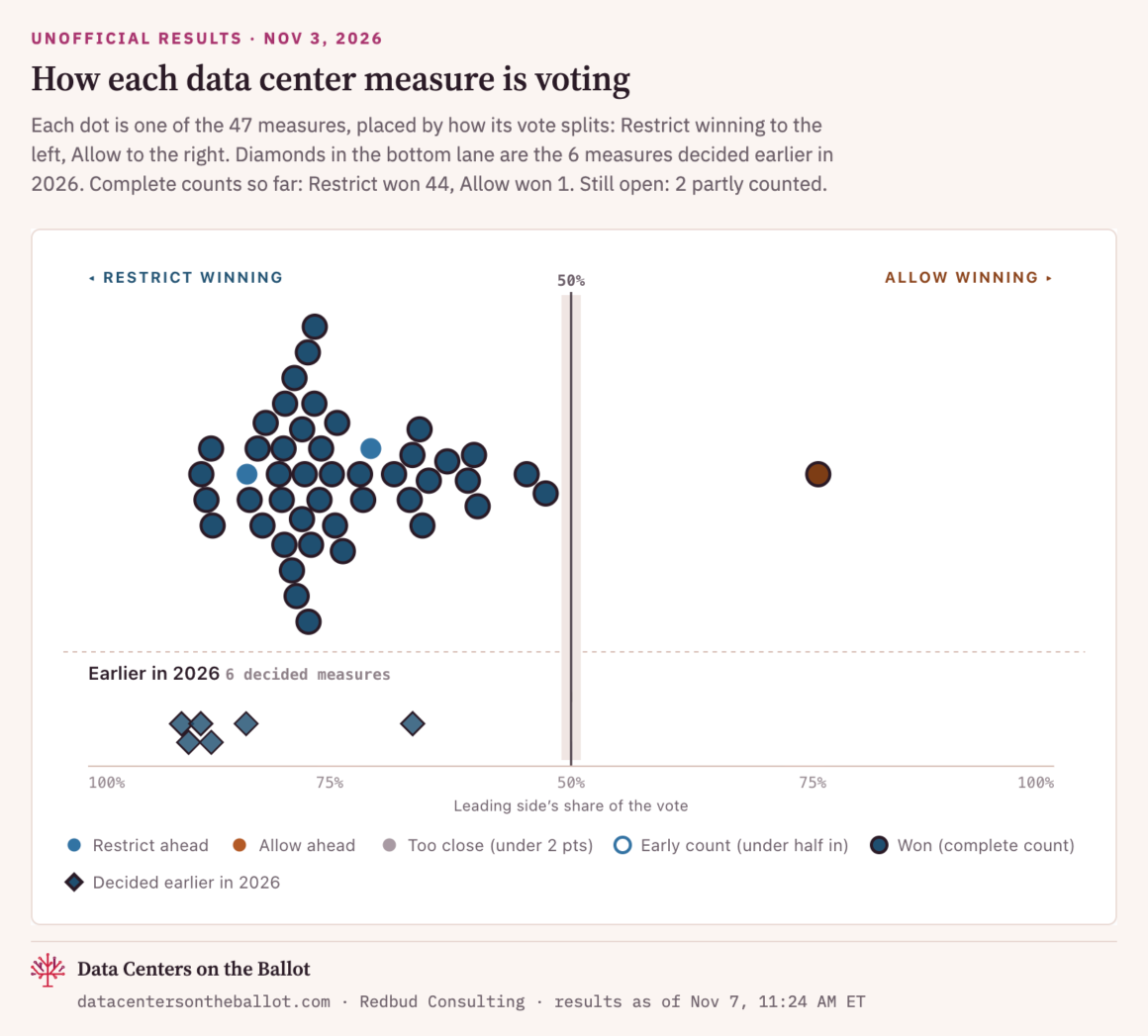
Data Centers on the Ballot / Redbud Consulting. Unofficial results as of Nov 7, 2026, 11:24 AM ET. Via Peter Walker.
The measures vary widely, from outright bans to megawatt caps to advisory councils. Some say “never.” Many say “not like this.” That is the state of play.
There is a chink of light, the winning candidates generally promised “pauses and new rules, not bans.” Ohio’s incoming governor, Amy Acton, has called for conditions including union labor and developers paying their utility costs. Texas was already restricting approvals under Republican Governor Greg Abbott before Democrat Gina Hinojosa won. But real decisions about how to allow the growth of AI are urgent.
It is not simply Democrats against AI. [Heatmap’s reporting](https://heatmap.news/plus/the-fight/spotlight/was-this-really-the-data-center-election) finds communities voting against data centers while continuing to support Republicans for higher office. It also questions whether opposition to data centers explains the broader electoral swing.
But Democrats now have an opportunity to turn resistance into a governing program. The important question is whether their conditions provide a route to building, or become a succession of reasons why building never happens. And if building never happens the transformation of health and education will slow down also, as will the possibility of distributing growing wealth.
[Thursday’s tech selloff](https://www.axios.com/2026/11/05/nasdaq-plummets-correction) reflected fears about a slower AI buildout.
### Distribution needs production
Wealth is a word that describes our capacity to produce useful things: electricity, homes, medicine, transport, education and tools that help people act on their ideas.
Money gives people a claim on those things. Redistributing money can change who gets access, and that can improve lives immediately. But if we want everybody to enjoy better housing, better healthcare and more opportunity over time, we also need to expand what we can produce.
The strongest objection is that people have heard promises like this before. They are asked to accept disruption now and trust that prosperity will reach them later. Meanwhile, the companies making the promises want favorable tax treatment, access to scarce resources and permission to transform their communities.
A family worried about its electricity bill is not obliged to take comfort in a forecast of national productivity. A worker facing displacement needs more than an assurance that new jobs will eventually appear. A community has every right to ask what it receives in return.
I agree with those objections. Growth does not automatically distribute itself fairly. But that is an argument for changing who benefits from growth, not for abandoning it.
The risk for anti-AI Democrats is that they replace an unfair growth model with no growth model. If their answer to concentrated ownership is to make productive capacity harder to build, while seizing past wealth through taxes, they have not given their constituents a larger stake in the future. They have made that future smaller.
### What is the victory for?
A party serious about redistribution has to be equally serious about production. It cannot promise a permanently improving standard of living while treating the means of improvement primarily as a threat.
Democrats have won the opportunity to govern. I want them to use it to make more things possible for more people. That means building the energy, intelligence and institutions through which people can create wealth and share in it. And it should work on a plan for equity to be gifted to a Human Wealth Fund that all have a share in. The Trump accounts and Elon Musk’s gifting of a share in SpaceXAI to all 18 and under are examples. A Human Wealth Fund would be the largest possible version of that approach. It is worth saying that the fund would have a no transfers or sales rule so that a citizen continued to get benefits, and expiry at death so that those benefits did not extend to inheritors who would own their own share.
Will Democrats use their new power to negotiate a better future, or mainly to prevent one from being built? A serious focus on ownership and how to deliver the benefits of AI is urgently needed from them.