The Rich Getting Richer
Can Venture Backed Growth be Shared?
## Editorial:
The Rich Getting Richer
Can Venture Backed Growth be Shared?
Yesterday, Anthropic opened its doors to public investors at $83 a share. They bought $81.34 billion of shares in the base offering. Today the underwriters exercised their option on another 147 million shares, taking the total to about $93.5 billion. More than $90 billion committed to a company whose future is still being built.
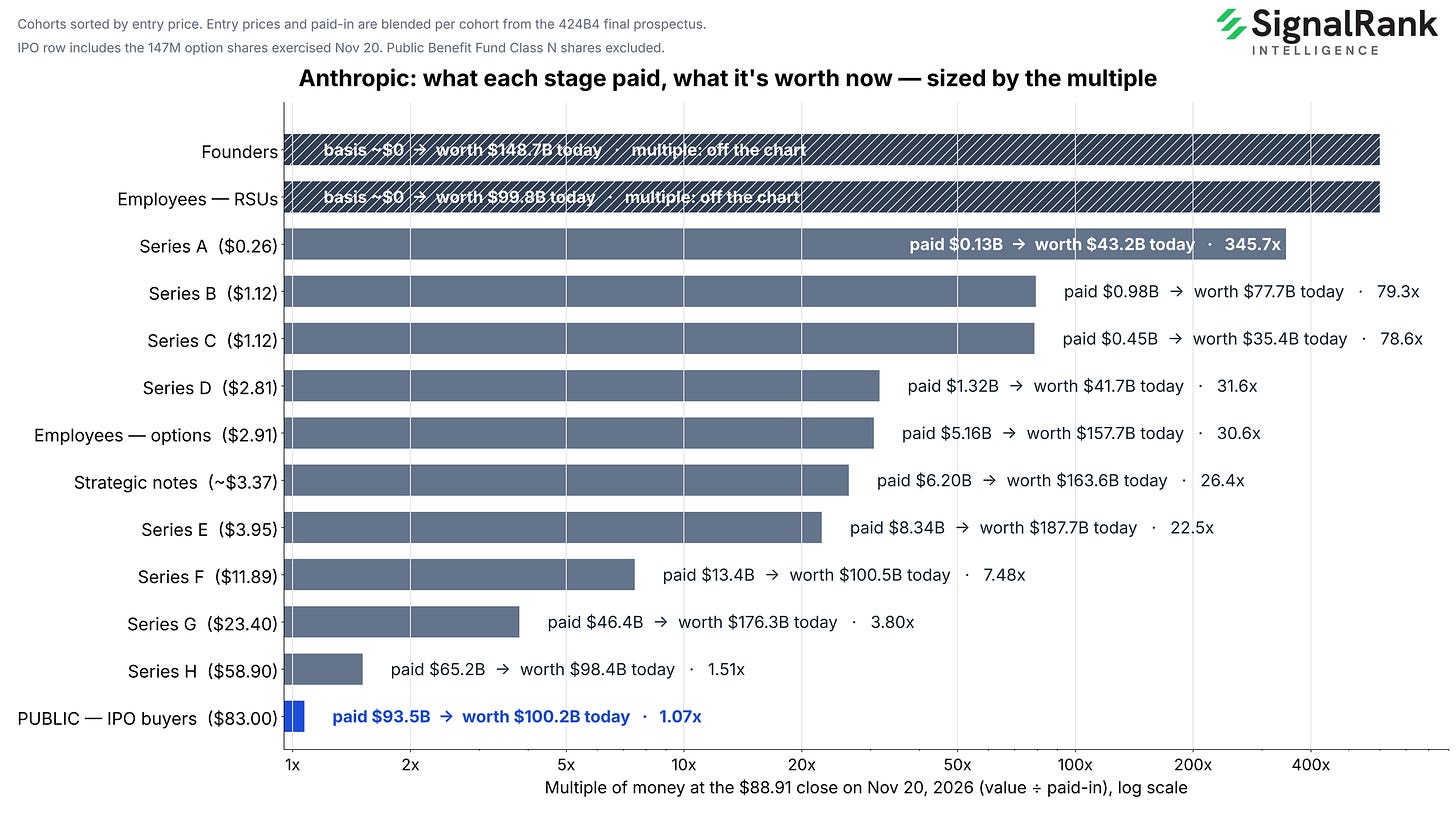
Four years earlier, Series B investors entered at a blended $1.12 a share. The eventual total for that financing was $980 million. Almost $1 billion.
Today, at a closing price of $88.91, the difference is straightforward.
Series B investors have a gain of $87.79 per share. Investors who received shares at the IPO price have a gain of $5.91. Anyone who bought at Thursday’s first-day close of $97.17 is down $8.26.
The same company. The same closing price. Very different participation in its growth.
In dollars, the roughly $980 million of Series B capital is now worth about $76.8 billion more than it cost. The $93.5 billion that came in through the IPO is worth about $6.7 billion more.
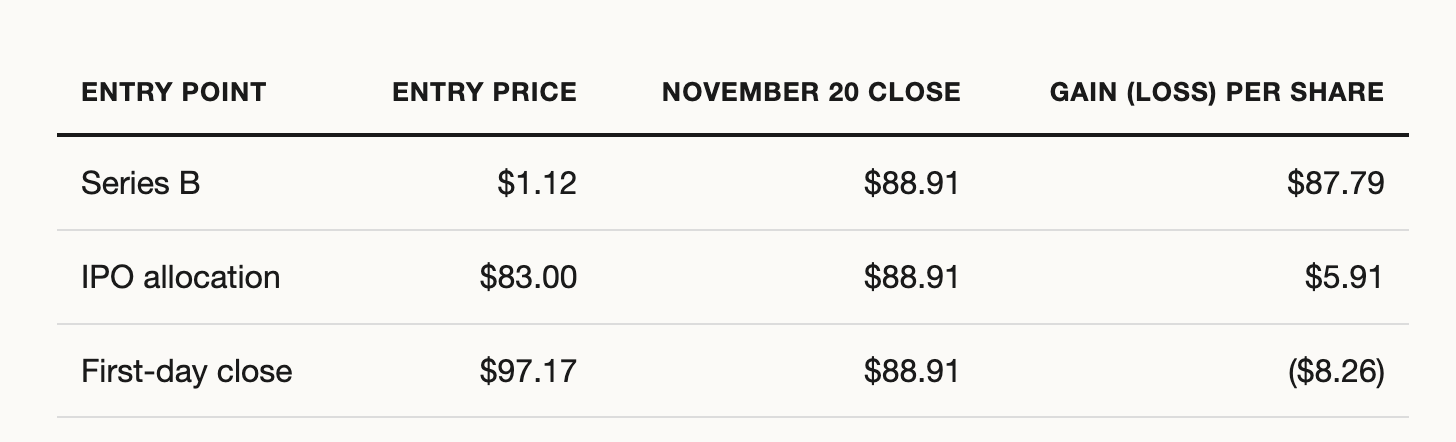
Calculated from the rounded entry prices in the [Anthropic cohort workbook](https://docs.google.com/spreadsheets/d/1ekDHTWyaiU4Gv9wejWXMA9Ul63J6sAyVlbp0hko056Q/edit). These are marked gains, not necessarily realized proceeds. The investors took different risks over different holding periods. Dollar totals are approximations derived from the blended Series B price and the final IPO share count.
### This is good news. It should be good news for more people.
If you read this newsletter you know that I am optimistic about Anthropic. I want it to keep building, keep making intelligence more useful and keep creating value. I expect it will. An economy in which ambitious companies can grow this much is doing something important right.
The rich getting richer is not, by itself, the complaint. That is a by-product of the way venture capital works. Early entry into winners is rewarded. The question is why participation in that growth is so difficult for regular people.
The early investors did not buy a certain outcome. Series B is de-risked, but there is still risk. And $1 billion was risked. They committed capital when the company was smaller, the technology less proven and the risks greater. They waited. Their reward reflects that.
But choosing not to take an early risk is one thing. Being unable to participate in the first place is another.
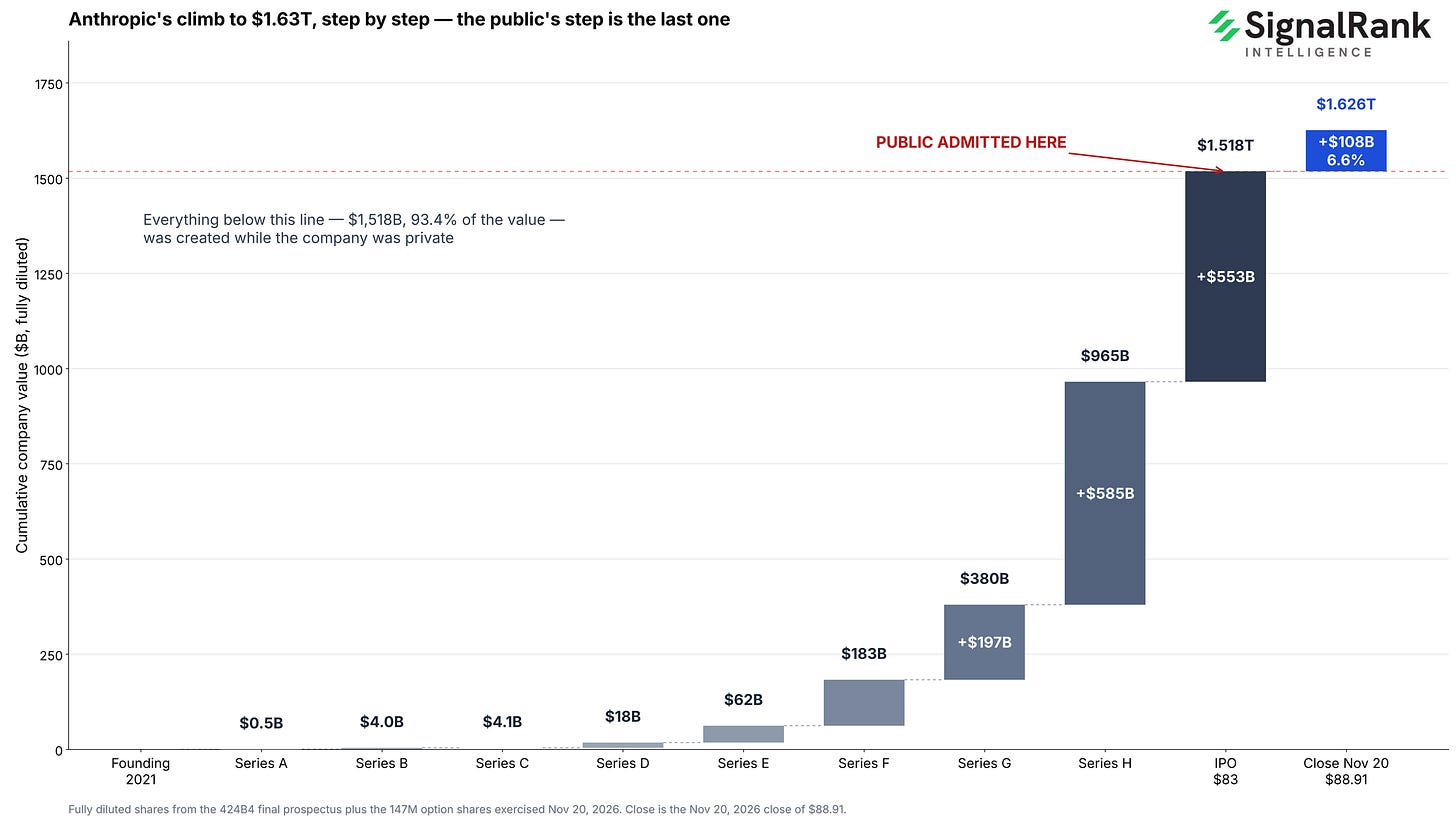
Access to an IPO does not compensate for not being able to access the growth that made the IPO possible. Public investors may have plenty of upside ahead. But being optimistic about that future does not repay the lost value due to not participating earlier.
### Regulation and the public
Why can’t the public buy earlier?
A major reason is regulation. Accredited-investor rules restrict participation in many private offerings, using wealth, income and specified qualifications to determine who is eligible. Exceptions exist, but they do not make a sought-after private financing broadly available to ordinary investors. Eligibility is one hurdle; actually securing an allocation is another. [SEC: accredited investors](https://www.sec.gov/resources-small-businesses/capital-raising-building-blocks/accredited-investors).
The intention is good - investor protection. The consequence is that people are protected from losing money early and also shut out when an early investment succeeds.
[ANT](https://finance.yahoo.com/quote/ANT/) finally becoming available does not solve that problem.
### Change the system
Public Venture Vehicles change how the public can own high-growth venture companies at an early stage. The recent rise of closed-end funds like [BOT](https://finance.yahoo.com/quote/BOT/) shows what is possible.
A closed-end fund that is a venture investor buys stakes in companies early. Retail investors buy shares in the vehicle. The companies stay private. Their growth becomes something the public can own. The fund enters at Series B. Owning the fund is open to all.
The public need not wait for each company to hold an IPO. It can own part of the portfolio while the businesses are still growing.
The structure solves an access problem for the public. It still requires investment judgment by the fund. It still needs real allocations made available by the companies, sensible entry prices, diversification and fees that leave the investor with a worthwhile share of the outcome.
Of course, a listed share can trade below the value of its assets. Losses remain possible. None of that defeats the idea. A Series B at over 70x gain has a lot of room to trade below value and still be a great holding.
While no fund can promise to identify the next Anthropic, a fund can own a portfolio early, before anyone knows which companies will become one. So it will need a diversified de-risked strategy.
The right to buy after a company has become valuable is not democratization. It is a way for the public to pour over $90 billion into a fully valued company and then hope for more growth. Democratization should involve access alongside early stage investors via de-risked vehicles with liquidity via listing. It should mean early entry and a share of the growth.
So after this week, let’s keep the growth. Open the ownership.
The rich get richer. Let more people into the process.
---
Source notes: The underwriters exercised the 147,000,000-share option in full on November 20, taking the IPO to 1,127,000,000 shares and about $93.5 billion gross, alongside a concurrent private placement of about $26.0 billion ([Anthropic closing announcement](https://www.anthropic.com/news/ipo-close)). The first-day close of $97.17 is as reported by Reuters. Dollar-gain totals are approximations: $980M at $1.12 is about 875M shares, times $87.79; 1.127B IPO shares times $5.91.
Disclosure: The author has financial interests in businesses pursuing approaches discussed here. This is editorial analysis, not a recommendation of a security or investment vehicle.
---